Heat Transfer Week 3
Heat Transfer Week 3
10 ANALOGIES BETWEEN MOMENTUM AND
HEAT TRANSFER terms
In forced convection analysis, we are primarily interested in the determination of the quantities and Nu. Therefore, it is very desirable to have a relation between Cf and Nu so that we can calculate one when the other is available. Such relations are developed on the basis of the similarity between momentum and heat transfers in boundary layers, and are known as Reynolds analogy and Chilton–Colburn analogy
- Convection heat transfer coefficient
- The rate of heat transfer between a solid surface and a fluid per unit surface area per unit temperature difference.
The convective heat transfer coefficient is dependent upon the physical properties of the fluid and the physical situation. The convective heat transfer coefficient is not a property of the fluid. It is an experimentally determined parameter whose value depends on all the variables influencing convection such as the surface geometry, the nature of fluid motion, the properties of the fluid, and the bulk fluid velocity.
- en: Coeficiente de transferencia de calor por convección

- Critical Reynold’s number
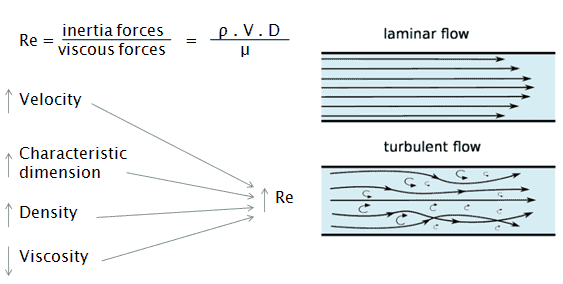
- The Reynolds number is the ratio of inertial forces to viscous forces and is a convenient parameter for predicting if a flow condition will be laminar or turbulent.
The critical Reynolds number is associated with the laminar-turbulent transition, in which a laminar flow becomes turbulent. This is an extraordinarily complicated process, which at present is not fully understood
- en: Número crítico de Reynolds

- Friction Coefficient
- Coefficient of friction is a measure of the amount of friction existing between two surfaces. When you find a coefficient of friction, you’re calculating the resistance to motion at the interface of two surfaces of similar or dissimilar materials.
- en: Coeficiente de fricción

- Kinematic viscosity
- The kinematic viscosity of the lubricants, i.e. the quotient of dynamic viscosity and oil density, is a function of the temperature and is a major factor determining the level of noise generated by transmissions.
This principle is based on the different flow times of gear oils through a defined measuring system. The elapsed time recorded is then the measure of viscosity. The viscosity–temperature diagram clearly shows the functional relationship with temperature. The lubricants investigated are made up of different oil bases and additives.
- en: Viscosidad cinemática
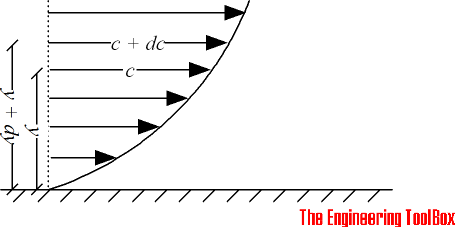
- Laminar flow
- Laminar flow, type of fluid flow in which the fluid travels smoothly or in regular paths, in contrast to turbulent flow, in which the fluid undergoes irregular fluctuations and mixing. In laminar flow, sometimes called streamline flow, the velocity, pressure, and other flow properties at each point in the fluid remain constant. Laminar flow over a horizontal surface may be thought of as consisting of thin layers, or laminae, all parallel to each other.
- en: Flujo laminar

- Nusselt number
- In fluid dynamics, the Nusselt number (Nu) is the ratio of convective to conductive heat transfer at a boundary in a fluid. Convection includes both advection and diffusion.The conductive component is measured under the same conditions as the convective but for a hypothetically motionless fluid. It is a dimensionless number, closely related to the fluid's Rayleigh number.
- en: Número de Nusselt

- Prandtl number
- The Prandtl number is a dimensionless quantity that puts the viscosity of a fluid in correlation with the thermal conductivity. It therefore assesses the relation between momentum transport and thermal transport capacity of a fluid. The Prandtl number is an example of a dimensionless number that is an intrinsic property of a fluid. Fluids with small Prandtl numbers are free-flowing liquids with high thermal conductivity and are therefore a good choice for heat conducting liquids.
- en: Número de prandtl

- Reynold number
- The Reynolds number helps predict flow patterns in different fluid flow situations. At low Reynolds numbers, flows tend to be dominated by laminar flow, while at high Reynolds numbers flows tend to be turbulent. The turbulence results from differences in the fluid's speed and direction, which may sometimes intersect or even move counter to the overall direction of the flow.
- en: El número de Reynolds
- Shear stress
- Shear stress, often denoted, is the component of stress coplanar with a material cross section. It arises from the shear force, the component of force vector parallel to the material cross section. Normal stress, on the other hand, arises from the force vector component perpendicular to the material cross section on which it acts.
- en: Esfuerzo cortante

- Turbulent flow
- Turbulent flow, type of fluid (gas or liquid) flow in which the fluid undergoes irregular fluctuations, or mixing, in contrast to laminar flow, in which the fluid moves in smooth paths or layers. In turbulent flow the speed of the fluid at a point is continuously undergoing changes in both magnitude and direction. The flow of wind and rivers is generally turbulent in this sense, even if the currents are gentle. The air or water swirls and eddies while its overall bulk moves along a specific direction.
- en: Flujo turbulento